
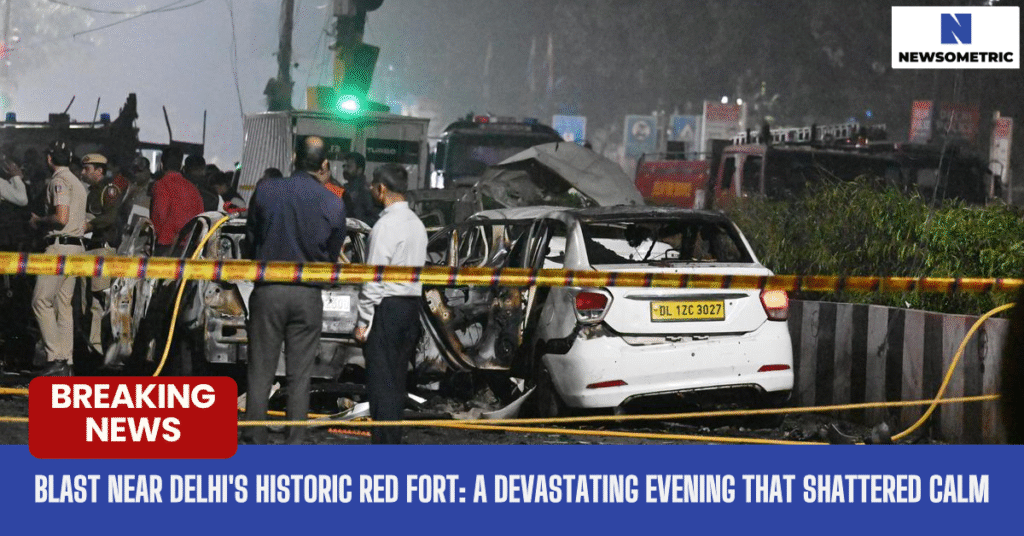
On the evening of Monday, November 10, 2025, a powerful explosion ripped through a car near the iconic Red Fort metro station in Delhi’s Chandni Chowk area, resulting in the tragic loss of at least nine lives and injuring more than twenty people. This sudden blast sent shockwaves across the capital, plunging a bustling market and tourist hotspot into chaos and raising urgent questions about security in one of India’s busiest and most historically significant neighborhoods.
The Incident and Immediate Aftermath
At approximately 6:52 PM local time, a Hyundai i20 car, waiting at a traffic signal near the Red Fort Metro Station Gate No. 1 on Subhash Marg, exploded with a force strong enough to ignite nearby vehicles and shatter windows in the vicinity. Eyewitnesses described scenes of carnage as people fled in panic, with body parts scattered and multiple vehicles damaged. Emergency services rushed to the scene, deploying fire tenders to control the resulting fire that engulfed six cars and three auto-rickshaws.
The blast occurred during peak evening hours, a time when the streets of Chandni Chowk are packed with shoppers, commuters, and tourists. The Red Fort, a UNESCO World Heritage Site, attracts thousands of visitors daily, making the timing and location of the explosion particularly devastating.
Casualties and Response
Delhi Police confirmed at least nine fatalities and 24 injuries, with many of the wounded rushed to nearby hospitals such as LNJP and AIIMS Trauma Center. Families of victims gathered outside hospitals in anguished scenes, desperately awaiting news on their loved ones. The Delhi government announced the closure of Chandni Chowk market as a precautionary measure.
Union Home Minister Amit Shah visited the site and the hospitals shortly after the explosion. He expressed deep condolences and assured the public that top investigative agencies, including the National Investigation Agency (NIA), National Security Guard (NSG), and the Delhi Police Special Cell, were conducting an intensive probe into the incident. Shah emphasized, “We are exploring all possibilities and will conduct a thorough investigation, taking all scenarios into account.”
Investigation and Security Measures
Investigators have invoked the Unlawful Activities Prevention Act (UAPA) and sections of the Explosives Act to facilitate a rigorous investigation into whether the blast was an act of terrorism. Early forensic analysis and intelligence inputs have suggested possible terror links, heightening alert levels in Delhi and multiple neighboring states.
The explosion occurred just hours after a significant cache of explosives was seized from two residential buildings in Faridabad, Haryana. The materials, including 350 kg of ammonium nitrate – a highly explosive chemical common in bomb making— were recovered following a tip-off related to a Jammu and Kashmir-based doctor. Authorities are probing any connection between this seizure and the Delhi blast.
Major transportation hubs and key installations across various states, including Mumbai, Uttar Pradesh, Rajasthan, Haryana, and Bihar, have been placed on high alert. Security at prominent religious shrines and tourist centers like Vaishno Devi has also been beefed up in response.
National and International Reactions
Prime Minister Narendra Modi expressed his condolences via social media, offering sympathies to the families of victims and wishing a swift recovery to the injured. The US Embassy in Delhi issued a security advisory urging American citizens in India to avoid crowded places and remain vigilant, reinforcing concerns over the broader security implications of the blast.
Eyewitness Accounts and Human Impact
Those working and living near the blast site recount a harrowing experience. Suman Mishra, who was descending stairs at the metro station when the explosion occurred, described hearing a loud bang followed by fire and mass panic among the crowd. An ambulance driver at the scene spoke of grim moments gathering dismembered bodies and rushing victims to hospitals amid chaotic scenes.
The blast has cast a shadow over the nation’s capital, shaking public confidence in safety at crowded urban landmarks. The devastating loss of life and injuries have drawn attention once again to the urgent need for heightened vigilance and robust security protocols in sensitive areas.
A City on Alert
Following the explosion, Delhi’s central industrial security forces raised security levels at metro stations, airports, and public government buildings. Police have cordoned off the blast area and are meticulously reviewing CCTV footage to trace the origin and those responsible for the attack. Investigative agencies continue to work around the clock to uncover any broader networks involved.
Questioning Security Failures: Where Did the System Falter?
While the Delhi blast near the Red Fort sent shockwaves of fear and grief across the capital, it also raised serious and unavoidable questions about the state of security preparedness and governance accountability. The incident occurred despite the extensive financial and administrative resources reportedly invested in safeguarding the national capital.
Security Spending vs. Ground Reality
India’s defense budget for the fiscal year 2025-26 stands at over ₹6.8 lakh crore (approximately $77.4 billion), marking a 9.5% increase from the previous year. A substantial portion of this allocation is dedicated to modernizing defense capabilities, operational preparedness, and infrastructural upgrades for frontline security forces. At the union level, Delhi’s security apparatus benefits from this allocation directly and indirectly through various agencies, including the Delhi Police, Central Industrial Security Force (CISF), and specialized units like the National Security Guard (NSG).
Despite these investments, the blast exposed glaring vulnerabilities. The car carrying the explosive device passed through multiple security checkpoints undetected, highlighting possible lapses in vehicle screening, perimeter security, and intelligence sharing among agencies. The fact that such a high-profile location—close not just to the Red Fort but a busy metro station and market—could be targeted so effectively points to systemic gaps.
Intelligence and Coordination Failures?
Authorities have publicly acknowledged that intelligence inputs about potential threats were either missed or not acted upon with the necessary urgency. The bust of a large terror module and seizure of explosives in nearby Faridabad, Haryana, which emerged days before this blast, should have triggered higher alert levels and preventive action in the National Capital Region (NCR).
Experts and opposition voices have questioned whether complacency, inter-agency coordination failures, or political dynamics interfered with timely threat assessment and deployment of preventive measures. A security analyst pointed out, “Discovering plots after the fact and hoping symbolic landmarks will deter attacks is a failure in strategic foresight.” The question remains—who bears ultimate responsibility for this critical breakdown in protective measures?
Government Accountability
Delhi’s law enforcement operates under a complex administrative structure reporting to the Union Ministry of Home Affairs through the Lieutenant Governor’s office. The center-state dynamic often complicates coherent decision-making, resource allocation, and ground-level implementation of security protocols.
Home Minister Amit Shah has called the incident “extremely serious and troubling” and promised swift action, yet critics demand more concrete accountability, including whether existing protocols, such as CCTV surveillance coverage, Automated Number Plate Recognition (ANPR) use, and mobile patrolling, are adequate and properly employed.
Questions are also mounting regarding the adequacy of security training, technology deployment, and equipment maintenance. For instance, how well are the frontline officers and paramilitary forces equipped to detect and neutralize high-risk threats in crowded civic spaces? Has infrastructure modernization kept pace with evolving terror tactics?
Public Concerns and Demand for Transparency
For citizens and business owners in Chandni Chowk and across Delhi, the blast has shattered a sense of security that has been eroded over years of terror alerts. The local market closures and increased police presence have disrupted livelihoods and daily life.
Civil society groups and opposition parties have demanded a transparent, speedy, and independent inquiry into the incident and the broader security architecture of Delhi. They insist on clear answers regarding what led to security lapses, what measures will be implemented to prevent recurrence, and how the government plans to reassure a wary public.
A Call for Systemic Overhaul
This incident underscores a critical need for a systemic overhaul of urban security frameworks to address intelligence gathering, inter-agency coordination, technological integration, and rapid response capabilities. Given the strategic and symbolic significance of sites like the Red Fort and the dense population in the NCR, the current approach to security requires both reassessment and urgent reforms.