


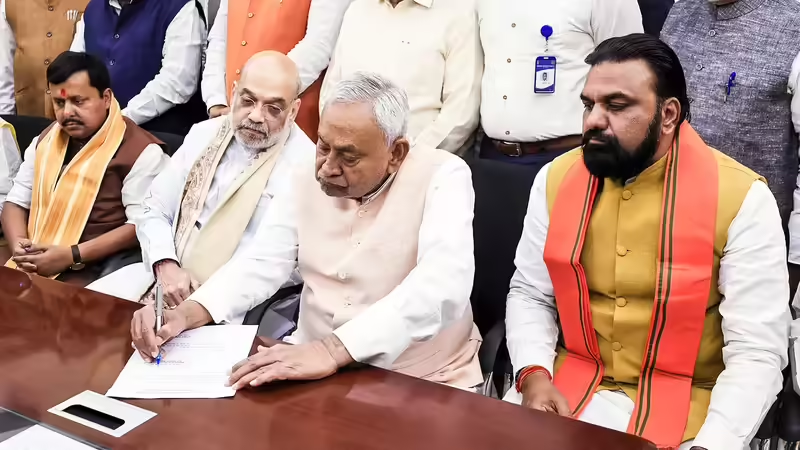
Nitish Kumar took oath as chief minister for the tenth time on 20 November 2025, after leading the National Democratic Alliance (NDA) – alongside Prime Minister Narendra Modi – to a sweeping victory in the Bihar Assembly elections. Less than four months later, he has chosen to relinquish the chief minister’s chair and seek a Rajya Sabha berth, effectively drawing down his two-decade-long centrality in Bihar’s day-to-day governance.
According to Moneycontrol, the JD(U) leadership was pushed towards a decision on Nitish’s future by persistent health concerns that had dogged him through his last term and raised questions over whether the bureaucracy, rather than the elected leader, was effectively running the state. The Indian Express report cited by Moneycontrol notes that videos from public appearances had fuelled concern about his health, and senior leaders concluded that a transition now would be better than a prolonged drift.
The move also comes just days after Nitish turned 75, a milestone that many parties informally recognise as a natural point to reconsider active executive roles. Yet as The Hindu’s editorial “Autumn of a socialist: On Nitish Kumar, the BJP and Bihar politics” underlines, the exit may look sudden but has been “in the making for several years”, reflecting both his long, shifting alliances and the BJP’s careful expansion into new regions and caste blocs.
BJP’s quiet outmanoeuvring and the succession puzzle
The Hindu’s editorial argues that the BJP has “quietly outmanoeuvred” Nitish Kumar, using the alliance to consolidate its organisational base and then positioning itself to head the government once his tenure wound down. For years, despite winning more seats than JD(U) in both the 2020 and 2025 Assembly polls, the BJP accepted Nitish as chief minister because of his personal popularity and the worry that dislodging him could destabilise the NDA. With his voluntary exit, the optics are smoother and the BJP can claim continuity while still taking the driver’s seat in Patna.

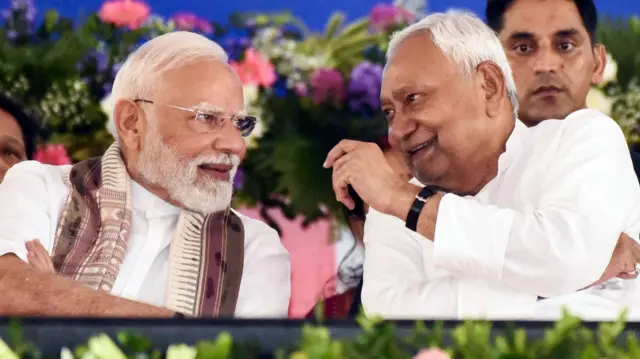
On the ground, attention has shifted swiftly to the question: who succeeds Nitish Kumar? NDTV reports that the BJP has informally decided that the next chief minister will be from its own ranks, but the party’s reputation for springing surprises has done little to calm speculation in Patna’s political circles. According to NDTV’s report from the state capital, at least six names are being discussed: Deputy Chief Minister Samrat Chaudhary, Union Minister of State for Home Nityanand Rai, Digha MLA Sanjeev Chaurasia, former minister Dilip Jaiswal, MLA Gayatri Devi, and Janak Ram from the Ravidas community, who could be projected if the BJP opts for a Dalit chief minister.
Each potential pick is read through Bihar’s layered matrix of caste and geography. NDTV notes that Samrat Chaudhary, from the Koeri caste closely linked to Nitish’s Kurmi base, is seen as a natural bridge to retain the Kurmi–Koeri axis that underpinned JD(U)’s strength, though his origins in Lalu Prasad Yadav’s Rashtriya Janata Dal (RJD) lead some BJP insiders to question his “core” credentials. Nityanand Rai, a Yadav and close aide of Union Home Minister Amit Shah, is touted as a way to cut into RJD’s core Yadav support, but the party has already appointed a Yadav chief minister in Madhya Pradesh, raising questions about balance across states.
NDTV’s report also highlights arguments for a chief minister from a backward caste or Dalit community – such as Janak Ram or Gayatri Devi – as part of a wider BJP strategy to broaden its social coalition beyond traditional upper-caste support. However, local voices quoted in the report underscore that while the chief minister will be from the BJP, “a name cannot be finalised without the blessing of Nitish Kumar”, suggesting that the outgoing leader’s leverage inside the alliance is not entirely exhausted.
Health, strategy and whether the exit was pre-scripted
One of the central questions asked by The Times of India’s detailed political analysis is whether pushing Nitish aside so soon after his November 2025 swearing-in was always part of the script. The report points out that he became chief minister less than four months ago, and his move to the Rajya Sabha neatly clears the path for the BJP to install its first chief minister in Bihar and “deepen its footprint across much of north and central India.”

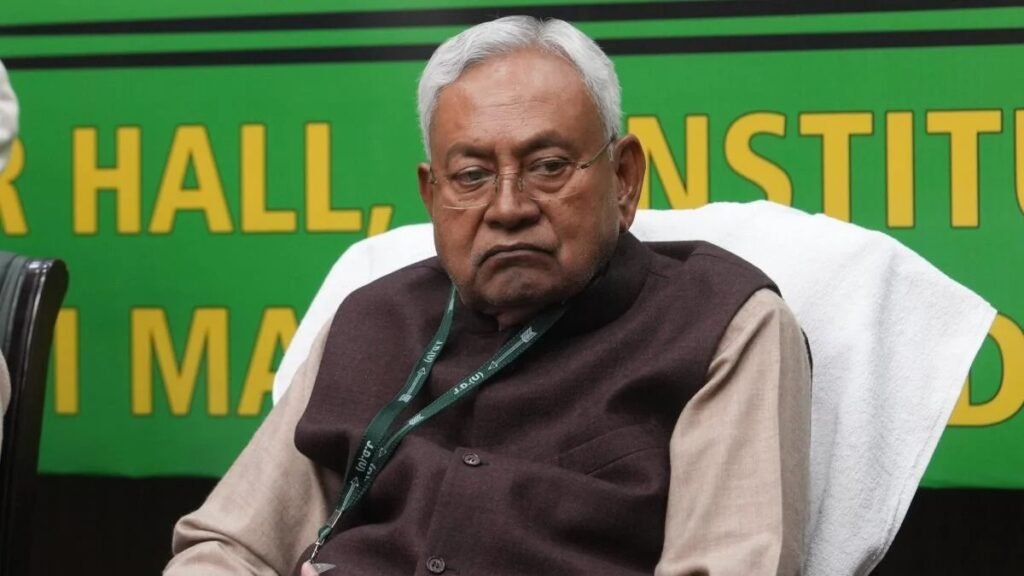
According to the Times of India’s political correspondents, there are two ways to read this compressed timeline: as primarily a response to health issues and governance concerns, or as the execution of a longer-term BJP–JD(U) understanding in which Nitish would front the NDA in the election but hand over mid-term. Moneycontrol, citing reporting in The Indian Express, leans more heavily on the health argument, quoting JD(U) sources who say they felt the chief minister was struggling and that “it’s the bureaucracy that’s running Bihar now”.
Yet, as The Hindu editorial notes, the pattern mirrors the BJP’s broader national strategy – partnering with regional parties to gain a foothold in states where it is weaker, then gradually reversing the hierarchy within the alliance. Observers recall similar trajectories in other states where regional allies saw their space shrink once the BJP had consolidated its vote share and organisational presence.
For Nitish himself, this is not the first major pivot. Over the last decade, he has oscillated between alliances with the BJP and with the RJD–Congress bloc, seeking to balance ideological discomforts with pragmatic calculations about stability and governance. The Hindu’s editorial frames the current “autumn” as less a sudden fall than the culmination of a long journey in which a socialist politician navigated coalition compulsions, personal ambition and a changing national landscape dominated by the BJP.
Nishant/Nishant Kumar’s entry and the dynastic question

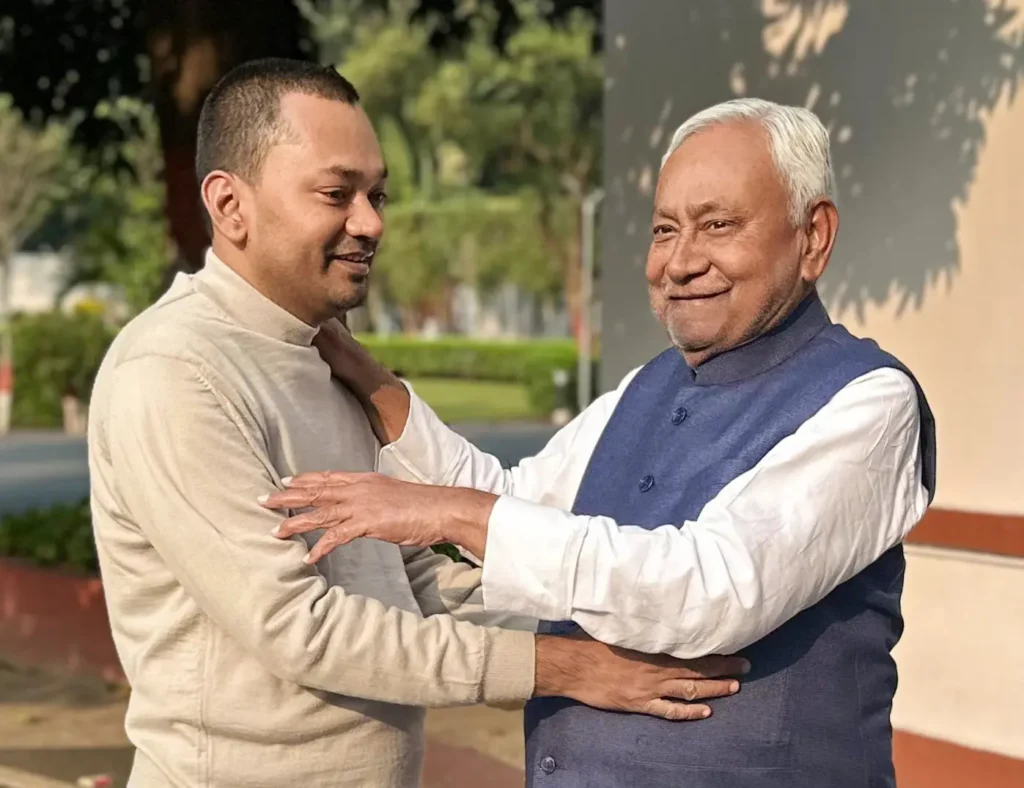
Parallel to Nitish Kumar’s exit from active state politics is the quiet but significant move to bring his son, Nishant (also reported as Nishant or Nishant Kumar), into JD(U). Moneycontrol reports that JD(U) leader Neeraj Kumar confirmed Nishant will formally join the party on 8 March, after years of staying away from public life despite recurring speculation about his political future.
This development is striking because Nitish has long positioned himself as a critic of dynastic politics, often drawing a contrast between his own choices and those of regional parties built around political families. According to Moneycontrol’s political desk, party leaders described Nishant’s entry as a “historic moment”, but also acknowledged the mixed emotions among workers who both respect Nitish’s legacy and recognise the contradiction with his past anti-dynasty rhetoric.
Moneycontrol’s explainer on “Who is Nishant Kumar and will JD(U) make him deputy CM?” notes that many JD(U) workers have been lobbying for his entry for years, seeing him as a possible unifying figure for the party’s future. The report raises – but does not conclusively answer – the question of whether he will be made deputy chief minister in a future arrangement, possibly under a BJP chief minister, as part of a calibrated succession plan.
JD(U) spokesperson Neeraj Kumar, quoted by Moneycontrol, stressed that a recent meeting at Nitish’s residence focused on the chief minister’s own decision to step down and on the party’s emotional response to it. Leaders reportedly expressed “difficulty and grief” over the move but pledged to stand by him “as you made the party,” underscoring that Nitish remains the moral centre of JD(U) even as operational control may shift over time.
Legacy, BJP’s expansion and what Bihar’s transition signals
Beyond the immediate succession manoeuvres, the current churn forces a re-examination of Nitish Kumar’s legacy and of the BJP’s long-term project in Bihar. As The New Indian Express profile previously argued, Nitish’s key contribution to Bihar has been a combination of infrastructure upgrades and social empowerment, especially for women and marginalised communities, alongside a relatively peaceful communal climate even within a BJP-led coalition.
The Hindu’s editorial echoes this view, suggesting that Nitish’s politics remained “quietly syncretic”: he backed both an off-campus centre of Aligarh Muslim University in Kishanganj and the foundation stone of a major Sita temple in Sitamarhi, attempting a calibrated balance rather than overt polarisation. Yet Bihar still struggles with slow industrialisation, heavy out-migration and patchy welfare delivery, limitations that critics say Nitish’s governance could not fully overcome.
For the BJP, assuming the chief minister’s post in Bihar is about more than a single state; it strengthens the party’s dominance across the Hindi heartland and reinforces a national narrative of steady expansion. A BJP chief minister in Patna, backed by a relatively weakened JD(U) with a new and untested heir apparent, could allow the party to reshape policies, messaging and candidate selection with fewer constraints from coalition arithmetic.
However, as NDTV’s reportage from Patna streets shows, ordinary voters and local political workers are also weighing the risks of an abrupt change at the top, particularly at a time when economic uncertainty and social tensions remain live concerns. Many voices cited in the NDTV story emphasise that Nitish’s “blessing” will still matter in keeping the NDA coalition intact and in managing caste equations, at least in the immediate term.
In that sense, the “autumn” of Nitish Kumar’s political career may not be an abrupt fall but a gradual fading into a mentor-like role, even as a new BJP-led government takes charge in Bihar and JD(U) experiments with transferring its legacy to Nishant Kumar. Whether this experiment stabilises Bihar’s politics or opens up a new phase of churn will depend on how smoothly the succession is managed – and whether the BJP’s choice for chief minister can command both the state’s complex social coalition and the confidence of a still-influential socialist veteran.